


How to speak multiple languages without constantly mixing them up

Full disclosure: This post contains affiliate links. ?
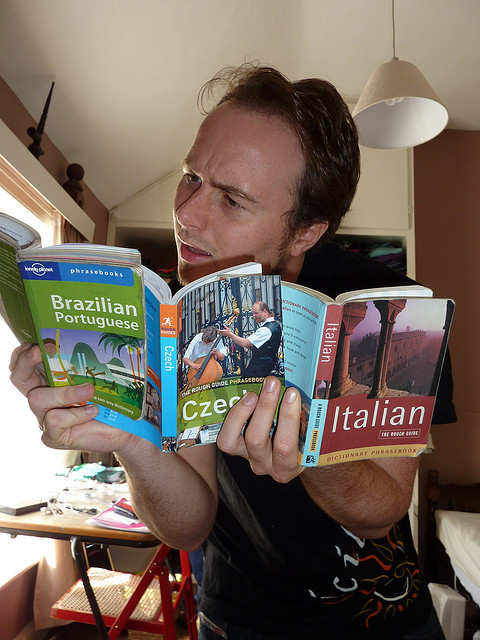
Being able to speak multiple languages is brilliant, but the languages can sometimes compete for your attention. That doesn't mean your brain is getting hopelessly confused.
When I was living in Spain and could still speak only English, I hung out with a Brazilian who absolutely wowed me at our international meet-ups. He would talk to me in flawless English, make an aside to another Brazilian in Portuguese, turn over his shoulder to say something in French, then shout over to the group organiser in Spanish. He made it look effortless.
There was less than a second between switches. How was he keeping the languages separate?
Watching him influenced my decision to devote the next several years to learning languages. Later, at a Couchsurfing meeting in Budapest, I pretty much did what my Brazilian friend had done, but in seven languages. I could have used even more, but nobody present would have understood them.
I didn't noticeably mix them up that evening, my accent was pretty good in each one, and I shifted my rhythm, body language and facial expressions with each language. One of the Brazilians said it was almost as good as talking with one of his buddies from home. A couple of minutes later, the Spaniard on my other side said exactly the same thing in Spanish. I was switching between the languages in an instant.
Some of those languages were closely related: Spanish, French, Italian and Portuguese are all Romance languages. The others were less similar to that group, although English and German are related to each other, while Hungarian belongs to another language family.
These are the habits that helped me maintain conversational ability in several languages and switch between them with fewer mix-ups.
A note from the Fluent in 3 Months team before we get started: You can chat away with a native speaker for at least 15 minutes with the “Fluent in 3 Months” method. All it takes is 90 days. Tap this link to find out more.
Mixing languages is normal
A multilingual person's languages don't sit in perfectly sealed boxes. A word from the wrong language can pop up, especially when the languages are similar or you haven't used one for a while. That's ordinary cross-language interference, not proof that you've failed.
With practice, switching can become fast and comfortable. My aim isn't to prevent every slip forever, but to make the language I want easier to retrieve in the moment.
Taking on several languages
I've already written about how to become a polyglot. These are the parts of my approach that matter most here:
- If you can, start with a language that feels more approachable. I chose Esperanto, which let me experience speaking another language sooner and gave me confidence for the next one.
- I prefer to focus on one new language at a time. Learning two at once isn't impossible, but it divides your time and can create more opportunities for interference. My own approach is to build one language to a useful conversational level, then maintain it while I focus on the next.
- Be ready to feel like a beginner again. Speaking one language well doesn't spare you the frustrating early stage of the next one, and I've gone through that reset many times.
- A language from the same family, such as the Romance languages, may give you loads of familiar vocabulary and patterns. That can make learning easier, but similar words can also compete when you speak. Pay attention to how each language sounds and works instead of treating the new one as a copy of the old one.
Spoken practice matters
My central piece of language-learning advice is still to speak. Study can build your vocabulary and understanding, but if you want to speak spontaneously, you need practice retrieving the language while you talk. That regular use is a major reason I can switch between my languages.
Even when I was in Budapest and Berlin, I met up with Spanish, French and Italian speakers. Keeping those languages active made switching into them much easier for me.
Maintaining every language at the same level takes more time than I want to give it, so I've sometimes chosen to let one become rusty after leaving the country. That's what I did with Czech and Catalan, and at the time I expected to do the same with Hungarian. You don't need endless passion or a daily conversation to maintain a language, but you do need a sustainable reason and routine for bringing it back into use.
My first serious attempt at speaking two foreign languages was in Rome, where I worked at a youth hostel while learning Italian and met loads of Spanish guests. At the time, Spanish was the only language besides English that I could use confidently.
At first, I produced a kind of “espaliano” when I tried to speak either one. Using Spanish with guests while also practising Italian gave me repeated chances to notice the differences and recover when the wrong word appeared.
One exercise that helped me was using both languages on the same day once I could already speak one of them confidently. Moving between them made the contrasts clearer and gave me direct practice at switching.
You can practise a language without travelling, and the schedule doesn't have to be daily. A regular conversation with a proficient speaker or fellow learner gives you a reason to retrieve the language in real time.
Being able to switch between accents
I'm pretty proud that, while my accents aren't perfect, I work hard to make my pronunciation clearer and settle into the sound of each language. You can see me switch between eight languages in this 2010 video.
I build those sound and context cues into every stage of learning. I think of it as a personal “persona” for each language, not a stereotype about everybody who speaks it.
When I learn a new French word, I don't just say it in my head or visualise it on a flashcard. I say it aloud, paying attention to the French sounds and the mouth position I need to make them.
For Spanish, I settle into its rhythm and pronunciation by remembering how my friends speak. I don't learn only that voiture is a French word for “car” and coche is a common Spanish word for it. I practise each word with the sound, voice and real situations I associate with that language.
Not mixing them up
Those cues make some words feel strongly tied to one language for me, although an occasional slip is still normal.
Spanish and Portuguese are similar, but I practise the Spanish infinitive hablar with Spanish pronunciation and in Spanish sentences. Portuguese uses falar. The more often I retrieve each verb in its own context, the less likely I am to reach for hablar when I'm speaking Portuguese.
If hablar does intrude while I'm speaking Portuguese, it now sounds immediately out of place to me.
This is why context matters. A translation can get you started, but repeated use helps you retrieve the word in the language you want. The mixed portuñol phrase você habla, Portuguese você with Spanish habla, feels wrong after enough experience with the Portuguese você fala.
After enough correct use in context, I don't have to stop and explain the grammar to myself. I can often feel it in my gut that the wrong-language word doesn't belong there.
Sound, rhythm, memory and non-verbal cues can all help you settle into a language.
You can rehearse alone and learn loads through reading and listening, but spontaneous conversation is its own skill. If that's your goal, find people to speak with, accept that you will sometimes mix things up, and keep giving your brain chances to retrieve the right language in real time.

Social