


Spanish Culture: Traditions, Etiquette, and History of Spain

Full disclosure: This post contains affiliate links. ?
Spanish culture is better understood in the plural. Spain has 17 autonomous communities, two autonomous cities, several co-official languages, and local traditions that can change within a short train ride.
This guide focuses on Spain rather than the whole Spanish-speaking world. It covers the history behind some famous landmarks, three widely known festivals, practical etiquette, art, flamenco, food, languages, sport, and modern Spain. Think of the examples as starting points, not rules that describe every person in the country.
I’m Kelsey, and I’ll be your guide. I’ve been learning Spanish for years and have travelled all across the country. The biggest lesson from those trips is simple: listen to how people describe their own region, language, and customs before assuming that one version represents all of Spain.
¡Vamos! (Let’s go!)
If you want a clear structure for putting your Spanish into practice, take a look at the Fluent in 3 Months Bootcamp. It’s a 90-day programme with weekly coaching calls, a private community and a focus on speaking from day one.
Table of contents
- The Building Blocks of Spanish Culture: From Romans to Moors and Beyond
- Celebrating Life the Spanish Way: A Kaleidoscope of Festivals
- Navigating Spanish Etiquette and Social Customs: A Friendly Guide
- Art and Literature: The Beating Heart of Spanish Culture
- The Flamenco Tradition: A Dance of Soul and Passion
- Spanish Cuisine: A Delicious Dive into Tradition and Flavor
- The Regional Diversity of Spain: A Country of Many Cultures
- La Liga and Beyond: The Heartbeat of Spanish Sports Culture
- Modern Spain: A Beautiful Blend of Tradition and Innovation
- Celebrating the Vibrant Spirit of Spain: An Invitation to Discovery
The Building Blocks of Spanish Culture: From Romans to Moors and Beyond
Spain’s history cannot be reduced to a neat sequence in which one culture simply replaced another. Roman forces began their conquest of the Iberian Peninsula in 218 BCE, and Roman rule developed over roughly two centuries. Latin became the basis of the languages now spoken across most of Spain, while Roman roads, aqueducts, cities, and legal traditions left visible traces.
After the Visigothic period, a Muslim-led army crossed into the peninsula in 711. The territories known as al-Andalus changed borders and rulers many times over the following centuries. Scholarship, agriculture, craft, architecture, and trade developed through contact among Muslim, Christian, and Jewish communities, although their relationships also included hierarchy, conflict, and persecution. “Moor” is a broad historical label, not the name of one uniform people or culture.
The Alhambra in Granada is one surviving part of that history. Here’s a photo I took there:
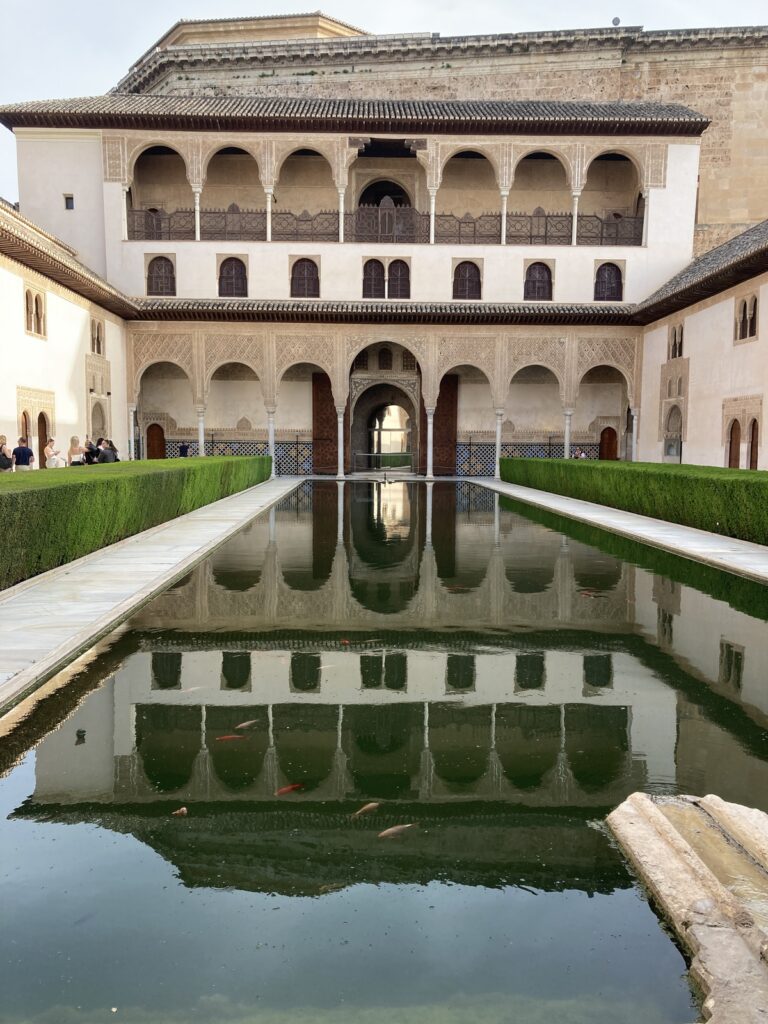
Christian kingdoms expanded south over centuries, a process often called the Reconquista. The conquest of the Nasrid kingdom of Granada in 1492 ended Muslim political rule on the peninsula. The same year, the Alhambra Decree ordered Jews who would not convert to leave the kingdoms of Castile and Aragon. Forced conversion and persecution affected both Jewish and Muslim communities in the years that followed.
Modern Spain was also shaped by its overseas empire, the Civil War of 1936–1939, Francisco Franco’s dictatorship, and the transition to democracy after his death in 1975. The 1978 Constitution established the present parliamentary democracy and system of autonomous communities. That longer view helps explain why a Roman aqueduct, an Andalusi palace, a Gothic cathedral, and a memorial to recent political violence can all belong to the same country without telling the same story. For a deeper overview, the Spanish Ministry of Foreign Affairs publishes Spain: A Global History.
Celebrating Life the Spanish Way: A Kaleidoscope of Festivals
Spain has hundreds of local and regional festivals. The three below are famous internationally, but they are not a national checklist, and plenty of people in Spain never take part in them.
La Tomatina: The Ultimate Tomato Fight
La Tomatina is held in Buñol, in the Valencian Community, on the last Wednesday in August. The organised tomato fight traces its origin to a fight among young people in 1945. It is now a ticketed event, and the details can change from year to year, so check the official Spain tourism listing before planning a trip.
It is playful and spectacular, but it is specifically Buñol’s festival. Calling it “what Spaniards do” would be like using one town’s celebration to sum up an entire country.
Semana Santa: A Week of Solemn Beauty
Semana Santa, or Holy Week, is marked in different ways across Spain. Some cities are known for large public processions, especially in Andalusia, while other places have quieter observances or little public participation. The events have religious meaning for many participants and historical or artistic interest for others.
Here’s a procession I photographed in Segovia:
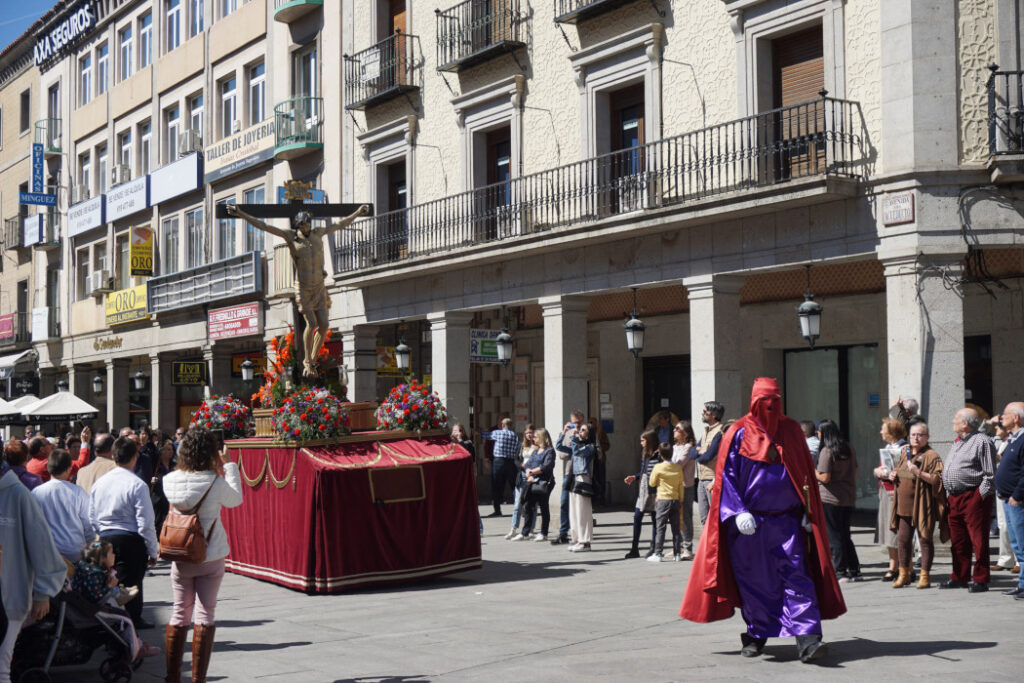
The roles in a procession are easy for a visitor to mix up. Nazarenos, or penitents, may walk in long robes and pointed hoods, while costaleros carry the heavy religious floats called pasos in traditions such as Seville’s. The pointed hood is centuries-old Catholic penitential dress and is unrelated to the Ku Klux Klan. Customs and names vary by brotherhood and region.
The processions I watched moved sloooowly. Check the route and timing locally, and remember that you are watching an act of devotion as well as a public event.
San Fermín: Running with the Bulls
Pamplona’s San Fermín festival runs from 6 to 14 July. Its best-known event is the encierro, when runners and fighting bulls move through a fenced route to the bullring on the mornings of 7–14 July. The wider festival includes a religious procession, music, giant figures, local clubs, and fireworks.
Running is genuinely dangerous, with injuries possible even for experienced participants. The use and later killing of bulls also attracts animal-welfare opposition. Watching or attending does not require pretending those concerns do not exist. Use the Pamplona City Council’s San Fermín portal and current safety rules if you plan to go.
Navigating Spanish Etiquette and Social Customs: A Friendly Guide
Etiquette changes with age, relationship, setting, and region. The safest approach is to arrive on time, follow your host’s lead, and ask when you are unsure.
The Flexible Spanish Clock
Spain does tend to run later than many visitors expect, especially around meals. Restaurants commonly serve lunch from about 13:00 to 16:00 and dinner from 20:00 to 22:30, sometimes later in large cities or in summer. Those are service windows, not proof that everyone has a “relaxed” attitude to time.
For work, tickets, appointments, and a first meeting, be punctual. For a social invitation, ask what time people will actually arrive instead of guessing. Our guide to telling the time in Spanish will help with the answer.
Greetings: The Warm Spanish Welcome
A handshake works for a professional or first meeting. Two cheek kisses, often called dos besos, are common in many informal situations, but who uses them and when varies. They are usually light cheek-to-cheek touches rather than actual kisses. Let the other person initiate and do not assume physical contact is expected.
A simple hola works almost anywhere. Buenos días, buenas tardes, and buenas noches add a little formality. You can find many more options in our guide to Spanish greetings.
Spanish, also called Castilian, will generally be understood. In communities with another official language, you may also hear Catalan, Valencian, Galician, Basque, or Aranese. A local greeting such as Catalan bon dia can be a friendly gesture, but language choice can carry personal and political meaning. Follow the speaker’s preference rather than treating the local language as decoration. Our introduction to Catalan is a useful starting point.
Do’s and Don’ts in Social Situations
A few practical habits are more useful than a list of claims about “what Spaniards are like”:
- Do ask your host or observe where people sit when you are invited into someone’s home.
- Do allow for conversational overlap without assuming that every lively exchange is an argument. Speaking styles vary from person to person.
- Do check whether food is meant for the table. Tapas may be shared, but they may also be individual portions, depending on the bar and region.
- Don’t assume a fixed tip is required. Service is included; rounding up or leaving a small amount for good service is optional.
Art and Literature: The Beating Heart of Spanish Culture
Spain’s visual art and literature span many languages, regions, and political periods. A short introduction can only point you towards a few doors.
Masters of the Canvas: Goya, Picasso, and Dalí
Francisco de Goya moved from court portraiture to the unsettling Black Paintings, while Pablo Picasso’s Guernica became an enduring response to the bombing of the Basque town during the Civil War. Salvador Dalí’s surrealist work turned dreams, bodies, and landscapes into deliberately strange images.
Those three names are famous, but they do not cover Spanish art. Museums and local collections also open up the work of artists such as Diego Velázquez, Joaquín Sorolla, Maruja Mallo, Remedios Varo, and many living artists.
Don Quixote: Spain’s Literary Giant
Miguel de Cervantes published the two parts of Don Quixote in 1605 and 1615. It is often called the first modern novel, although that label is a critical judgement rather than a settled fact. Its play with narrators, genres, reading, and reality had an enormous influence on later fiction.
The original early modern Spanish is difficult for many learners. I’ve read bits of it in a graded reader for Spanish reading practice, and I highly recommend that route. You can enjoy the story without beginning with the hardest possible edition.
The Modern Spanish Cinema and Literature
For cinema, Pedro Almodóvar’s films are an obvious entry point, while directors such as Isabel Coixet, Icíar Bollaín, Alejandro Amenábar, and Carla Simón show very different sides of life and filmmaking in Spain. Our list of Spanish-language films on Netflix has more learner-friendly ideas, although availability varies by country.
In literature, Carlos Ruiz Zafón and Javier Marías were influential writers of the late 20th and early 21st centuries; neither is still living. Rosa Montero, Javier Cercas, Irene Vallejo, and Sara Mesa are among the many contemporary writers worth exploring. Remember that literature from Spain is also written in Catalan, Galician, Basque, and other languages.
The Flamenco Tradition: A Dance of Soul and Passion
Flamenco is not shorthand for all Spanish dance. It is a specific art form with its heartland in Andalusia and roots in places including Murcia and Extremadura. UNESCO added it to the Representative List of the Intangible Cultural Heritage of Humanity in 2010.
Origins: A Hybrid of Cultural Influences
Flamenco’s origins are complex and partly disputed. Andalusian musical traditions developed through centuries of contact, exclusion, and exchange. Gitano, or Spanish Roma, communities played an essential role in creating and transmitting the art, alongside other communities in southern Spain. A simple claim that flamenco is a tidy fusion of four cultures hides that history.
If you’re in Granada, I highly recommend the Sacromonte Caves Museum. Its bilingual exhibits give useful context about cave homes, Gitano life in Sacromonte, and flamenco. I thought it was absolutely awesome.
Here’s a photo I took from the museum grounds, looking across the valley towards the Alhambra:
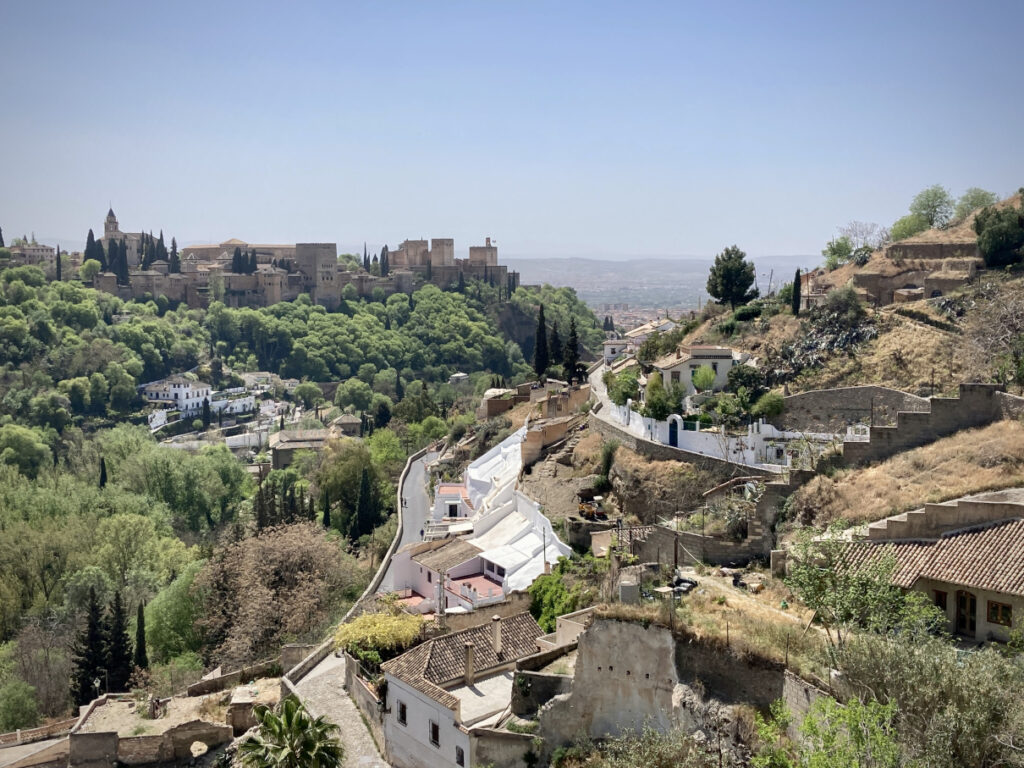
The view places two famous parts of Granada in the same frame, but a photograph cannot by itself explain the city’s history of inequality. The museum’s exhibits provide the context that the landscape alone cannot.
The Elements of Flamenco: Cante, Toque, Baile
Flamenco brings together cante (singing), toque (instrumental playing, especially guitar), and baile (dance). Handclaps, finger snapping, footwork, and percussion may also shape a performance. Different rhythmic and melodic forms are called palos, and each has its own conventions and mood.
UNESCO’s flamenco entry is a good place to read about the tradition without reducing it to costumes or a tourist show.
Spanish Cuisine: A Delicious Dive into Tradition and Flavor
Food in Spain is regional, seasonal, and much broader than the three dishes most visitors know. Our Spanish food vocabulary guide will help you read a menu while you explore it.
Iconic Spanish Dishes: Paella, Tapas, and Gazpacho
- Paella: Paella comes from Valencia. Traditional paella valenciana commonly includes rice, chicken, rabbit, and local beans, although other established rice dishes use seafood or vegetables. The squid-ink rice I enjoy is normally called arroz negro, not paella.
- Tapas: A tapa is a small serving, but the format changes by region and venue. Some come free with a drink, some are ordered separately, and some are shared. In parts of northern Spain you will see pintxos, often displayed on the bar and sometimes served on bread.
- Gazpacho: This cold Andalusian soup is usually based on tomato, olive oil, and vegetables, but recipes vary. I’ve even made a good version using watermelon rind.
A Taste of Regional Diversity
Regional examples make more sense than a single “Spanish menu”. Galicia is known for seafood, octopus, and hearty breads. The Basque Country has pintxos and a renowned restaurant culture. Catalonia has dishes such as pa amb tomàquet, and the Canary Islands have papas arrugadas with mojo sauces. Andalusia has gazpacho, salmorejo, fried fish, and many local variations.
Even those labels are only introductions. Family recipes and local ingredients matter more than a tidy national list.
Meals and Dining: When and How?
Lunch is often the main meal, and dinner is commonly later than in northern Europe or North America. Official tourism guidance gives approximate restaurant hours of 13:00–16:00 for lunch and 20:00–22:30 for dinner, extending to about 23:30 in some cities and summer destinations. Check locally, especially outside tourist centres.
Sobremesa is the time spent talking at the table after a meal. It is a useful word, not a promise that every lunch becomes a long social occasion. For current practical details, see Spain’s official visitor information.
The Regional Diversity of Spain: A Country of Many Cultures
Regional diversity is not a decorative extra. It affects government, education, language, food, media, and how people describe where they are from.
Spain’s Autonomous Communities
Spain consists of 17 autonomous communities and the two autonomous cities of Ceuta and Melilla. Each community has its own institutions and statute of autonomy, with powers that vary by policy area. Catalonia, Galicia, Andalusia, and the Basque Country are useful examples to compare, but avoid turning them into personalities such as “proud”, “mystical”, or “laid-back”. Concrete differences in law, language, festivals, and food tell you more.
The Spanish government’s territorial overview lists all 17 communities and both autonomous cities.
The Linguistic Diversity of Spain
Article 3 of the Spanish Constitution makes Castilian the official language of the state and allows other Spanish languages to be co-official in their autonomous communities under their statutes.
The main co-official languages are Catalan, including the official name Valencian in the Valencian Community; Galician; Basque; and Aranese, an Occitan variety official in Catalonia. Catalan is also co-official in the Balearic Islands, and Basque has official status in the legally defined Basque-speaking area of Navarre. Naming and identity can be politically sensitive, especially around Catalan and Valencian, so listen to how local speakers describe their language.
Basque is a language isolate: linguists have not demonstrated a genealogical relationship with another living language. That is more precise than saying it is simply “unrelated to any language in the world”. Smaller and non-official varieties matter too, including Asturian, Aragonese, Leonese, Fala, Caló, and others. Our article on less widely taught languages explains why these communities deserve attention.
La Liga and Beyond: The Heartbeat of Spanish Sports Culture
Sport is highly visible in Spain, but no sport unites everyone. Club, regional, political, and family loyalties can be as important as national teams.
La Liga: Where Football Legends Are Made
La Liga includes globally famous clubs such as Real Madrid and FC Barcelona. Their rivalry, commonly called El Clásico, is long-running rather than centuries-old: the clubs were founded in 1902 and 1899. Local clubs and women’s football also have strong followings, so Spain’s football culture is much bigger than two teams.
Beyond Football: A Country in Love with Sports
Basketball, cycling, tennis, handball, motorsport, and many other sports have large audiences. Rafael Nadal retired from professional tennis in 2024 with 22 major singles titles, including a record 14 at Roland Garros. The ATP’s career retrospective has the current figures.
Modern Spain: A Beautiful Blend of Tradition and Innovation
Historic centres and traditional festivals exist alongside dense rail networks, renewable electricity, laboratories, universities, and changing cities. “Modern Spain” is not one lifestyle any more than “traditional Spain” is.
Blending History and Development
High-speed trains link many major cities, often bringing a contemporary station close to an old centre. Heritage rules can protect buildings and streets while making new housing or transport harder to build. The result is an ongoing argument about what should change, what should be preserved, and who benefits.
Leading the Charge in Renewable Energy
Renewables produced 55.5% of Spain’s electricity in 2025, according to Red Eléctrica. Including estimated self-consumption raised the share to 56.6%. Those figures show substantial change without implying that the energy transition is complete. The operator’s 2025 system report explains what is counted.
A Hub for Technological and Scientific Innovation
The Gran Telescopio Canarias is a 10.4 m optical and infrared telescope at the Roque de los Muchachos Observatory on La Palma. It is not a radio telescope, and it is not on Gran Canaria. The Instituto de Astrofísica de Canarias gives its specifications.
That one correction is a useful reminder: claims about “innovation” are more informative when they name a real institution, place, and measurement.
Celebrating the Vibrant Spirit of Spain: An Invitation to Discovery
Spanish culture is not one personality shared by everyone in the country. It is a set of overlapping histories, institutions, languages, arts, habits, and arguments that look different depending on where you stand.
When you visit or study Spain, compare at least two regions. Listen for which language people choose, try a dish in the place it comes from, and ask how locals understand a festival or custom. You will learn more from those differences than from any list of stereotypes.
And keep learning the language. Even a short conversation gives you a chance to hear how someone describes their own home, rather than asking a guide to speak for the whole country.

Social