


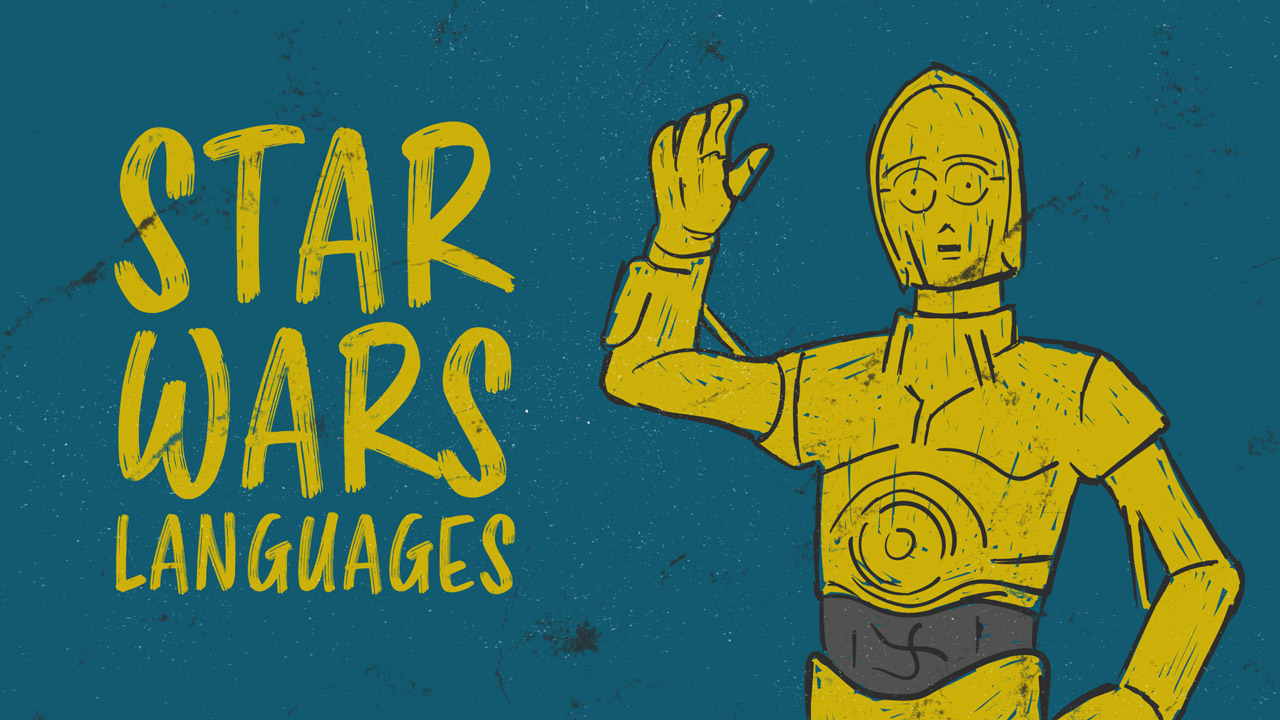
Star Wars Languages: Aurebesh, Mando’a and 6 Real Languages

Full disclosure: This post contains affiliate links. ?
Star Wars gives language learners two kinds of material to explore: fictional speech and writing systems from the galaxy, plus the vocabulary used to discuss the stories in real languages.
This guide starts with Aurebesh, Mandalorian writing and several forms of alien speech. It then gives you a compact Star Wars glossary in Japanese, Mandarin Chinese, Korean, Spanish, German and French.
Dubbed dialogue and subtitles can differ by country, platform and release. Treat the phrases below as a starting point, then note the exact wording used in the edition you watch.
A note from the Fluent in 3 Months team before we get started: You can chat away with a native speaker for at least 15 minutes with the “Fluent in 3 Months” method. All it takes is 90 days. Tap this link to find out more.
Table of contents
- Star Wars and Languages
- What Is Aurebesh? Learning the Galaxy’s Writing System
- Mandalorian Writing and Mando’a
- How Complete Are the Star Wars Languages?
- Star Wars Phrases and Slang from Canon Stories
- Star Wars in Japanese
- Star Wars in Mandarin Chinese
- Star Wars in Korean
- Star Wars in Spanish
- Star Wars in German
- Star Wars in French
- Use Star Wars to Practise a Language
Star Wars and Languages
Star Wars uses language in several ways. Characters speak fictional languages such as Huttese, while writing systems such as Aurebesh give familiar words a different visual form. Other speech was designed mainly for a scene, without enough published grammar or vocabulary for a learner to hold a new conversation.
That distinction matters. A script changes how language is written; a constructed language has deliberately invented linguistic material of its own. Both can be fun to study, but they are not the same task.
The second half of this guide uses one interest, Star Wars, to build real-language vocabulary. A small topic glossary gives you something concrete to look for in subtitles, reviews and conversations.
What Is Aurebesh? Learning the Galaxy’s Writing System
StarWars.com describes Aurebesh as a written system based on Galactic Basic. On screen, it often works as a substitution alphabet: each symbol corresponds to a familiar Latin letter, so you can transliterate signs and displays rather than learn a new spoken language.
Start with a short word, write one symbol at a time, then read it back without looking at the Latin letters. Use the Aurebesh.org writing field or preview text with the LingoJam Aurebesh converter. These are fan tools for checking symbol correspondences, not official translators; use the StarWars.com explanation above for canon context.
Mandalorian Writing and Mando’a
Mandalorian characters appear on armour, signs and displays, including the chain code Boba Fett shows Din Djarin. The writing can be transliterated, but the much larger Mando’a vocabulary that fans study was developed mainly in material now labelled Star Wars Legends.
Use the official StarWars.com archive for a short Mando’a text with its English meaning. For a broader Legends-era word list, consult the Mando’a entry on Wookieepedia and keep its fan-reference and continuity labels beside your notes.
If you explore the expanded Mando’a lexicon, keep its continuity label beside your notes. These examples come from Legends-era material, where official archive articles include a Mando’a war chant, rather than a complete current-canon course:
- Hello: Su cuy’gar
- Thank you: Vor entye
- Goodbye: Ret’urcye mhi
- Yes: Elek
- Armour: Beskar’gam
- Fight: Akaanir
How Complete Are the Star Wars Languages?
Conlang is short for constructed language: a language deliberately invented for a purpose such as a film, book or television series. Star Wars contains both constructed languages and shorter pieces of language-like sound design. Their depth varies.
Sound designer Ben Burtt has explained that he based Huttese on the sound and rhythm of Quechua. For Ewok speech, his team recorded speakers and combined material from several voices with animal sounds. Those production methods created convincing dialogue, but they did not automatically publish a full grammar for viewers to learn.
More recent productions sometimes build a larger system. For Andor Season 2, dialect coach Marina Tyndall created Ghor, and the production used scripted lines, pronunciation models and two written forms.
Signed communication also appears in the galaxy. Deaf actor Troy Kotsur helped develop the Tusken sign language used in The Mandalorian and The Book of Boba Fett. It is a fictional system made for those characters, not a substitute for American Sign Language.
This gives you a useful test: ask whether a system has documented sounds or signs, vocabulary, grammar and enough material to create new sentences. If it only supplies a few fixed lines, learn those as story vocabulary rather than assuming there is a complete language behind them.
Star Wars Phrases and Slang from Canon Stories
These terms appear in canon films, television episodes, novels or comics. The medium and scene matter, so keep the speaker and source with each expression instead of learning a one-word gloss in isolation.
- “Wizard!”: enthusiastic approval
- “Dank farrik”: a frustrated exclamation
- “Karabast”: a Lasat exclamation associated with Garazeb Orrelios
- “Buckethead”: a nickname or insult for a stormtrooper
- “Clanker”: a derogatory term for a battle droid
- “Nerf-herder”: the insult Leia uses for Han in The Empire Strikes Back
- “Thank the Maker!”: C-3PO’s grateful exclamation
- “This is the Way”: the creed repeated by the Children of the Watch
- “Moof-milker”: an insult Han uses in The Force Awakens; it also appears in Star Wars Resistance
- “Scrumrat”: Corellian slang for a street urchin, used of young Han in Solo
- “Gorg-face”: a harsh name heard in the Star Wars Resistance episode “Kaz’s Curse”
- “Laser brain”: Leia’s insult for Han in The Empire Strikes Back
- “Poodoo”: an exclamation used in the canon Marvel comic Star Wars: Bounty Hunters #10
- “Sleemo”: an insult used in The Clone Wars; StarWars.com describes Chairman Cho as a “self-important sleemo” in its rewatch of “Trespass”
- “Kriffing”: an expletive used in canon prose, including The High Republic: The Rising Storm
Try one phrase in a complete sentence about the scene. That turns trivia into active vocabulary.
Star Wars in Japanese
Many character and technology names are written in katakana. Long vowels matter in both spelling and romanisation:
- Star Wars: スター・ウォーズ, Sutā Wōzu
- Episode: エピソード, episōdo
- Darth Vader: ダース・ベイダー, Dāsu Beidā
- Princess Leia: レイア姫, Reia-hime
- Luke Skywalker: ルーク・スカイウォーカー, Rūku Sukaiwōkā
- Lightsaber: ライトセーバー, raito sēbā
- Jedi: ジェダイ, Jedai
- “May the Force be with you”: フォースと共にあらんことを, Fōsu to tomo ni aran koto o
Pick two katakana names and read them aloud before checking the romanisation.
Star Wars in Mandarin Chinese
These simplified-Chinese forms give you a short character and pinyin review:
- Star Wars: 星球大战, Xīngqiú Dàzhàn
- Episode: 集, jí
- Darth Vader: 达斯·维达, Dásī Wéidá
- Princess Leia: 莱娅公主, Láiyà Gōngzhǔ
- Luke Skywalker: 卢克·天行者, Lúkè Tiānxíngzhě
- Lightsaber: 光剑, guāngjiàn
- Jedi: 绝地, juédì
- “May the Force be with you”: 愿原力与你同在, Yuàn Yuánlì yǔ nǐ tóngzài
Cover the pinyin, read the characters, then uncover it to check tones and syllable boundaries.
Star Wars in Korean
Several names are transliterated into Hangul, while other terms use Korean vocabulary:
- Star Wars: 스타워즈, seutawojeu
- Episode: 에피소드, episodeu
- Darth Vader: 다스 베이더, daseu beideo
- Princess Leia: 레이아 공주, reia gongju
- Luke Skywalker: 루크 스카이워커, rukeu seukaiwokeo
- Lightsaber: 광선검, gwangseongeom
- Jedi: 제다이, jedai
- “May the Force be with you”: 포스가 함께하길, poseuga hamkkehagil
Use the character names to practise reading loanwords, then contrast them with vocabulary such as 공주, “princess”.
Star Wars in Spanish
The franchise is now commonly called Star Wars; La guerra de las galaxias remains familiar as an older title in Spain. Some vocabulary also varies by dubbing market.
- Episode: episodio
- Lightsaber: sable de luz or espada láser
- Jedi Order: la Orden Jedi
- Hope: esperanza
- Empire: Imperio
- Spaceship: nave espacial
- Galaxy: galaxia
- “May the Force be with you”: Que la Fuerza te acompañe
When a subtitle and dub choose different words, save both with their region and scene.
Star Wars in German
Star Wars is the current franchise name, while Krieg der Sterne is an older German title. Use these words to start a conversation in German about the films:
- Episode: Episode for a numbered saga film; Folge for a television-series episode
- Spaceship: Raumschiff
- Galaxy: Galaxie
- Trilogy: Trilogie
- Lightsaber: Lichtschwert
- Hope: Hoffnung
- Empire: Imperium
- “May the Force be with you”: Möge die Macht mit dir sein
Star Wars in French
Star Wars is the current franchise name; La Guerre des étoiles is the older French title. Notice that the noun “hope” is espoir, not the verb espérer.
- Episode: épisode
- Darth Vader: Dark Vador
- Lightsaber: sabre laser
- Hope: espoir
- Empire: Empire
- Spaceship: vaisseau spatial
- Galaxy: galaxie
- “May the Force be with you”: Que la Force soit avec toi
Write a two-sentence film opinion using one noun from the list, then check it with the French writing practice guide.
Use Star Wars to Practise a Language
A themed list becomes useful when you do something with it. Try this short routine:
- Choose one scene you already know.
- Watch it with audio and subtitles in your target language.
- Save five words with the exact sentence, speaker, region and edition.
- Retell the scene or discuss it with a tutor or exchange partner.
Repeat the same scene later without subtitles. Familiarity with the story frees up attention for sound, grammar and delivery. For a broader study plan, use the current guide to learning a language.
May the Force be with you.

Social